

- What is demography? Demography is the scientific study of characteristics and dynamics pertaining to the human population. The characteristics encompassed by this study include size, growth rate, density, vital statistics, and distribution of a specified population.
- In what year did the Australian population reach 20 million? How quickly is the population growing? On October 17 2003 the human population hit 20 million. On average the growth rate of the Australian population is by 2.0%
- How many Aboriginal people are estimated to have lived in Australia before Europeans arrived? The Indigenous population at the time of European settlement is estimated to have been at least 315 000.
- What the two main ways the population can grow? What percentage of the population growth in 2010 can be attributed to each way? Immigration and firtility rates.
- What is the total fertility rate for 2010? 1.9 per woman. 47% births and 53% immigrants.
- What was the total fertility rate for Australia in 1935? How does this compare to other years? Why do you think that it compares this way? 77.2 per 100,000 women it is much higher compared to all of the other years and I think it compares this way because they were just coming out of the great depression and it cost lots of money.
- What is the trend in the fertility rate for Australia since 1950? From the 1950s it decreases.
- What is the average size of a family in Australia? How does that compare to the US? The average size of a family in Australia is 2.5 people. The average family size in the US is 3.14 people. This shows that there is a higher average in the US, which would explain why there is a much higher population.
Subscribe To Olivers Geo Blog

 Posts
All Comments
Posts
All Comments
Monday, August 22, 2011
Australia's Population

Wednesday, August 17, 2011
Are we a racist nation?
http://goo.gl/zrTIW
- Who is the author and what is his job title? Graeme Innes and his job is Race Discrimination Commissioner.
- Who does he work for and what is supposed to do in this job? The National Press Club, his job is to try and figure out if there is racism in our country.
- What does the author say is often the beginning of a racist comment? Have you every heard anyone use this line to say something racist? If so, what did they say? What is often the beginning of a racist comment is 'i'm not racist but'... i have personally heard someone say those exact words, and a racist comment followed.
- What percent of Australians are born overseas or have an overseas parent? 50% of Australians are born overseas or have an overseas parent.
- What is a 'monoculture'? Mono cultures are where there is only one race in a certain area.
- What are some welcome benefits of online technology? They have connected some of the world's indigenous people and ethnic minority groups so they can share stories, co-ordinate with work and collectively organize.
- What are some unwelcome results of online social media? There are many race-hate websites, cyber-racism has been doubled in the past couple of years.
- What makes racism online so dangerous? The people who are saying the racist comments are able to be anonymous so that they are unaware of who is bullying. Also because many more people who would normally be to afraid to be racist, would have more courage behind a computer screen.
- What will help stop racism online? Anti-bullying campaigns, but government and social networking sites must come together to help.
- What does the author suggest we need to do to stop racism? We must call out racism when we see it, and then discourage all people who try to be racist.
How has Australia changed in your life time?
List some of the ways that Australia has changed in your life time.
Use the following categories: physical change, socio-economic change, and cultural change. Have five changes for each category.
Choose ONE example from each category (three total). What are some of the ways that we can find out how Australia has changed in each of these categories? What research could we do to figure out how Australia has changed?
For each of the THREE from above find an answer. Then write a paragraph about how you think the information you have found has led to change in Australia. (put all this information in the same blog post)
Physical: Floods, droughts, Sydney Olympic park; from bush land to sports centre, erosion, deforestation.
Socio Economic: Carbon tax, urbanisation, GFC, income levels, value of the Aussie $.
Cultural: Population, multiculturalism; people from other countries moving to Australia, Change in government, global warming, new religions.
For physical changes, there are many different ways in which we could gather information, and example is we could use before and after photos of Sydney Olympic park before the 200 Olympics and after the 2000 Olympics. For Socio economic changes, we could definitely view the Australian dollar from ten years ago, and the Australian dollar this year. There would be changes in the strength of it and for Cultural changes we would be able to find out information, by the current population of Australia, to the population of Australia in the year 2001. The population this year would definitely be much higher then 10 years ago.
The changes in Sydney Olympic park are huge. These two pictures below show that before the Sydney Olympic games occurred, Home bush was a very quite place, a nice bush land area, but when the Olympics began, all of that was destroyed. This has drastically changed Australia because it caused an increase in population, and many more people from other countries coming to live in Australia.

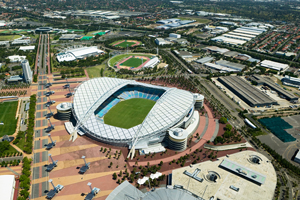
BEFORE AFTER
This graph below shows, that in the last two years alone, the Australian dollar has increased dramatically in value, this has caused many people to cash in and earn lots of money, which can again change Australia, with some possible citizens going away on long holidays away whilst it is cheap, and it getting cheaper.

The graph below also shows us that the population of Australia in the past 20 years has again increased dramatically.

Use the following categories: physical change, socio-economic change, and cultural change. Have five changes for each category.
Choose ONE example from each category (three total). What are some of the ways that we can find out how Australia has changed in each of these categories? What research could we do to figure out how Australia has changed?
For each of the THREE from above find an answer. Then write a paragraph about how you think the information you have found has led to change in Australia. (put all this information in the same blog post)
Physical: Floods, droughts, Sydney Olympic park; from bush land to sports centre, erosion, deforestation.
Socio Economic: Carbon tax, urbanisation, GFC, income levels, value of the Aussie $.
Cultural: Population, multiculturalism; people from other countries moving to Australia, Change in government, global warming, new religions.
For physical changes, there are many different ways in which we could gather information, and example is we could use before and after photos of Sydney Olympic park before the 200 Olympics and after the 2000 Olympics. For Socio economic changes, we could definitely view the Australian dollar from ten years ago, and the Australian dollar this year. There would be changes in the strength of it and for Cultural changes we would be able to find out information, by the current population of Australia, to the population of Australia in the year 2001. The population this year would definitely be much higher then 10 years ago.
The changes in Sydney Olympic park are huge. These two pictures below show that before the Sydney Olympic games occurred, Home bush was a very quite place, a nice bush land area, but when the Olympics began, all of that was destroyed. This has drastically changed Australia because it caused an increase in population, and many more people from other countries coming to live in Australia.
BEFORE AFTER
This graph below shows, that in the last two years alone, the Australian dollar has increased dramatically in value, this has caused many people to cash in and earn lots of money, which can again change Australia, with some possible citizens going away on long holidays away whilst it is cheap, and it getting cheaper.
The graph below also shows us that the population of Australia in the past 20 years has again increased dramatically.
Subscribe to:
Posts (Atom)