


Subscribe To Olivers Geo Blog

 Posts
All Comments
Posts
All Comments
Sunday, December 4, 2011


Sunday, November 6, 2011
Exercise 7.4: Managing the coastal environment
1. Coastal management is when trying to find ways that we can protect our environment.
2.
Construction of protective barriers
2.
Construction of protective barriers
· Beach Nourishment
· Coastal Dune Preservation
3. 3.
Brief description of management strategy | Advantages | Disadvantages |
Sea Walls and Groynes | Stops erosion and protects many beach front properties. Makes the beaches wider by catching the sands. | Is making the beach more ‘artificial’, more man made and is taking away the beauty of the beach. |
The moving of sand by humans | Clearing makes room for other things. | Very expensive and may be endangering many animals and plants. |
Preservation of coastal dunes | Helps to stop erosion and to make the beach areas more stable. | Less space for people to live along the coastline and a large possibility of introduced species endangering other animals and their habitats. |
4. 4. For coastal management to work, large amounts of attention needs to be paid to the environment to ensure that the environment is at the constant best that it can be.
5. 5.
5. 5.
| Description of problem | Proposed management solution/s |
| Fishermen from a coastal village anchor their boats in a small river. Recently the river mouth has been eroded by the ocean and the river entrance is no longer safe for ships for use. | Construction of protective barriers and walls. - Breakwaters. |
| A tourist development has been built behind a well-preserved sand dune system. Tourists wanting to access the beach are trampling and destroying fragile dune vegetation. | Coastal dune Preservation - Limiting new developments. |
| Developments along the coast have changed the shape of a safe swimming beach popular with families. It is often dangerous to swim. Hotel owners are demanding that the beach be restored to how it was before the developments. | Beach Nourishment |
| Storm waves frequently threaten to destroy property along the fore dune of a beach. | Construction of protective barrier and walls. |
Tuesday, November 1, 2011
Exercise 7.3 Geographical processes shaping the coastal environment
1. Hydraulic action, Corrosion and corrasion.
2. Wave refraction causes the wave energy to be concentrated in particular areas and less intense in others.
3. The waves are refracted and kinetic energy is formed.

 10. When waves travel at a certain angle, long shore drift occurs. The water then gets transported along the coast, along with all of the litter that is on the ground at the beaches.
2. Wave refraction causes the wave energy to be concentrated in particular areas and less intense in others.
3. The waves are refracted and kinetic energy is formed.
4. Coasts around the headlands.
5.
Hydraulic Action: Waves crash against a headland. Waves enter cracks in the rock and air is compressed into the crack by the force of the water being pushed by the wave. As the air is compressed it acts to erode rock. Blow holes are a common feature formed by hydraulic action.
Corrasion: Waves crash over rock shelves. The wave action moves rock and other material across the rock shelf and wears away the rock in an abrasive fashion.
Corrosion: Waves break the rocks. When it dries, the salt in the sea water crystallises and acts on the minerals in the rock to erode materials.
6. During severe storms beaches can lose large quantities of sand through erosion by waves. The sand that is deposited offshore, forming a sand bar off the beach where it helps to limit the impact of the erosive waves on the coast.
7. Wind, waves and ocean currents.
8. Along the coastline and at beaches.
9. Coastal dunes are formed by the action of the wind. Once sand is deposited on the beach it is then subject to aeolin (wind) transportation. The wind blows the sand landward, which is trapped by low-lying vegetation like coastal spinifex. The foredune is a store of sand. It may be eroded away, or it may continue to increase in size depending on wave and wind action.
10. When waves travel at a certain angle, long shore drift occurs. The water then gets transported along the coast, along with all of the litter that is on the ground at the beaches.11.
Blow holes: As waves crash into the headland, water is forced into cracks causing erosion.
Tombolos: Due to shallow water, water refracts and bends causing erosion. This erosion stays at a constant force causing areas of land to stick out.
Sea stacks: When sea gradually erodes soft limestone cliffs.
Offshore sand bars:When storms occur near the coast, loads of sand is taken out to sea causing large masses of sand called sand bars.
12. They provide a buffer zone for the fragile dune vegetation located on the hind dunes.
13.
a. The great road, Victoria.
b. They are very rare, so are a very profitable tourist attraction.
c. Wave erosion on the coastal headlands.
d. The London bridge was a natural bridge that linked the mainland to offshore rock.
e. I believe that it is just a natural process and that there could not have been anything done to stop it without hindering the environment.
14.
Good morning everyone! I am Oliver Rich and welcome to Port Campbell national park!! Now you can all see the Twelve Apostles behind me and today I am here to talk to you about them. Now the Twelve Apostles were created over 20 million years ago, and are known as sea stacks.They were created when parts of sand and rock slowly erode away certain spots, leaving these 12 to stand out by themselves. Now eventually all of the 12 Apostles will erode away and collapse, making this destination very unique, and only lasting for who knows how long.
15.
The local council has decided to buy back residential property located on a headland and a neighbouring fore dune which is subject to erosion. The residents of these areas are appalled by this and want to continue to enjoy the lifestyle and views they can now. Ms Kerry Woods aged 89 has spoken about this and has displayed her views. 'I am 89 years of age and live alone, I have no need for the nice views and the relaxed lifestyle, I say that if the council will pay me a high enough profit for my house I will move, I'm not too picky'. A young couple who have recently moved into this area and have shown their views too. 'We have only just moved here, and we think that the area is a lovely place for starting a family, and the view is fabulous! We knew that erosion was a problem and are always watching out, but really the council has no right to do that!
This is a very topical issue that has people everywhere arguing, tell us what you think at www.gnp.com.au
Wednesday, October 26, 2011
The Science of Big Waves
Design a blog post on your blog of a big wave site from different parts of the world. Be sure to describe the geography and the topography of the ocean floor in these areas and how this helps create these massive waves. check out http://www.extremehorizon.com/surf-shop/big_waves.html for big waves around the world.
Pre-viewing:
- Where do ocean waves come from? What gets them started? The waves come from thousands of miles off the coast created by the wind. The wind and energy along with the speed and size.
- What do you think a surfer should know about waves before they try and ride a wave while surfing? I think that a surfer should know the speed and strength of certain waves, and obviously if they are safe enough to ride.
Question for the Video:
- Observe all the waves that you see and describe how they form and break. Use as many words found in the segment for you descriptions. Waves form when the wind increases as does the speed. When the energy of a wave hits the low land the wave cycles are compressed and it creates a long wavelength.
- Describe how waves are formed, how they originate, and how they are measured? Waves are formed depending on the climate in the impact zone thousands of miles out to sea. They are measured in wave height and strength.
- What is a maverick wave and what is special about the way it is formed? A wave which crashes on the coast in California in Maverick. There are many rocks near the beaches so it creates very big waves.
- How is energy stored and transferred during wave? When the wind speed and the duration increase, energy is stored under the water chain in circular cycles. This then turns into kinetic energy creating large waves.
- List any kind of advice given by the surfers about how to survive these “big waves.” I would just make sure that they know what they are getting themselves into. They should study the wave before hand so that they know the possible dangers and so that they are safe.
Monday, October 24, 2011
Peahi (Jaws)

Peahi (Jaws):When severe storms occur in the Pacific, the resulting swell sends giant waves crashing onto the north shore of Maui. The waves are so intense that the spot has become known to surfers across the world as 'Jaws.' The waves of Jaws can reach up to 21m (70ft). The wave speed and wave length decrease in shallow water, therefore the energy per unit area of the wave has to increase, so the wave height increases.When the wave crest becomes too steep, it becomes unstable, curling forward and breaking. This usually happens when the height of the wave becomes about the same size as the local water depth.
Wednesday, October 12, 2011
Exercise 7.1 Questions: Geographical issues in the coastal environment
1. 85% of the Australian population live 50 km's of the coast. This densely populated area has affected the coastal environment with pollution, tourism and recreational pressures.
2. Many different groups of people use the beach and for residential needs, population growth and introduced plants.
3. Population Growth.
4.Residential caps. They restrict the population density.
5.
Tourism: Increasing people coming to the coasts for holidays which damages the ecosystem.
Population Increase: People moving to the coast from other inland towns.
Pollution: Humans polluting the coastal environment because of litter and other things.
Introduced Plants:Humans introducing new plant species which may benefit humans but hurt natural wildlife.
6. Assisting with tourism, residential and commercial activities.
7b.
a.
I am just writing to you to say that the views which I have seen from my new apartment are not as good as the pictures you have shown me, and I am wondering why. I have paid a very generous amount to live in this luxurious place with lots of space and I am very pleased with the inside, however the outside is not as I imagined. I expects to have one of the nicest views of the coast, but in fact I have a very nice view... of the car park. I am sending you a warning letter now because if I don't get a better room, I will put in an official complaint.
OLIVER RICH
2. Many different groups of people use the beach and for residential needs, population growth and introduced plants.
3. Population Growth.
4.Residential caps. They restrict the population density.
5.
Tourism: Increasing people coming to the coasts for holidays which damages the ecosystem.
Population Increase: People moving to the coast from other inland towns.
Pollution: Humans polluting the coastal environment because of litter and other things.
Introduced Plants:Humans introducing new plant species which may benefit humans but hurt natural wildlife.
6. Assisting with tourism, residential and commercial activities.
7b.
a.
I am just writing to you to say that the views which I have seen from my new apartment are not as good as the pictures you have shown me, and I am wondering why. I have paid a very generous amount to live in this luxurious place with lots of space and I am very pleased with the inside, however the outside is not as I imagined. I expects to have one of the nicest views of the coast, but in fact I have a very nice view... of the car park. I am sending you a warning letter now because if I don't get a better room, I will put in an official complaint.
OLIVER RICH
Wednesday, September 14, 2011
Extended Response Revision
Communities do not remain static, but continually experience change. There are many inter connected factors that contribute to the changes and differences between and within communities. In a world that is experiencing rapid globalisation it is important for decision-makers within communities to understand and respond to these changes
Describe the factors causing change in relation to Australia's communities.
Include in your response:
Describe the factors causing change in relation to Australia's communities.
Include in your response:
- the location of a community effected
- the specific characteristics of this community (eg. rural/urban, population, ethnicity, age, any other characteristics that make it a community).
- Description of the factors causing change in your chosen community.
- Describe the effects of those changes upon your chosen community.
The main factors which are causing change in my area, is that there are needs for more homes now, with the growing population. My area is off Canoon Road, South Turramurra, at the 'old horse paddocks', a place which was once just bushland is now new homes for many people. The old horse paddocks were set aside many years ago for a possible M2 route, but they decided against it. After this, the land was left alone until now. The community surrounding it are both happy and mad. They believe that it is a good thing that it is finally being put to some use, but a bad thing that it is being used for homes, and because of this, many animals will lose their natural habitats. The biggest effect that this construction has on the old horse paddocks is that there will be an increase in traffic, which is also because of the local tennis and netball courts around the corner.
Sunday, September 11, 2011
Chapter 4.3: Strategies and Actions in Response to change in Gulargambone
pg 117: 1-12a-f (9A2 - Due Fri 16/9) (9B2 Due - Tue 13/9)
1. The Australian Government's Department of Transport and Regional Services and The NSW Department of State and Regional Development.
2. The town life development program and the sense of a place program.
3. It is the first community owned post office in Australia, this means that the threat of closure is banished as it will always be opened.
4. The GRTC offers Giropost, Centrelink, Medicare, Internet access and the Reliance Credit Union along with the usual postal services and a small, but modern gift shop.
5. Most of the strategies and actions in response to the changes that have occurred in Gulargambone over the last 10 years have been instigated and developed by community groups. These groups have lobbied government and non-government organisations for funding and assistance. Without the proactive attitude of the community and individuals, Gulargambone would not have the services and facilities that are available today.
6.
1. To increase the population and services that are available
2. To improve the visual appearance of the town
3. To promote Gulargambone
7. The two eight two eight project involved the restoration of the former picture theatre into a vibrant and multi-faceted community centre.
8.
The opening of the Rural Transaction Centre and the first community - owned post office in Australia
Lobbying for and receiving a new new multi-purpose health centre
The 'Back to Gulargambone reunion, 2001' that hosted 2000 visitors - four times the population- for a long weekend filled with activities and money-raising for local projects.
9. Coonamble Shire Council has provided funding and help with many of the projects undertaken in Gulargambone including dollar-for-dollar funding for repainting the shops in the main street and funding the feasibility study for the Rural Transaction Centre. Coonamble Shire Council has been supportive and has provided financial assistance for many of the projects.
10. We can clearly see that the before and after photos show the beneficial changes which occurred to the building. The old building looks old and non functional, whereas the new building looks very new and very functional and efficient.
11. Active citizenship in a small town like Gulargambone is a very important thing. With small towns, they are not very well noticed, and so with the help of the entire community, they could find a way to put them on the map and more noticeable. The entire community can come together to make a difference to their town and their lives, and they can do many things.
12.
a. The article is about Gulargambone and them fighting for the survival of their town.
b. The collapse of the economy of their town and the drought.
c. This has caused the closing of many businesses and shops, such as petrol stations and banks.
d. The reason the community galvanised into action is because the government threatened to shop down their hospitals and post office, with the closest ones being hours away.
e. The other post office is over two hours away, creating major inconveniences.
f. The town painted and restored many shops and the 2828 building.They also got a new town logo: a galah, which they created statues of throughout highways and the town
1. The Australian Government's Department of Transport and Regional Services and The NSW Department of State and Regional Development.
2. The town life development program and the sense of a place program.
3. It is the first community owned post office in Australia, this means that the threat of closure is banished as it will always be opened.
4. The GRTC offers Giropost, Centrelink, Medicare, Internet access and the Reliance Credit Union along with the usual postal services and a small, but modern gift shop.
5. Most of the strategies and actions in response to the changes that have occurred in Gulargambone over the last 10 years have been instigated and developed by community groups. These groups have lobbied government and non-government organisations for funding and assistance. Without the proactive attitude of the community and individuals, Gulargambone would not have the services and facilities that are available today.
6.
1. To increase the population and services that are available
2. To improve the visual appearance of the town
3. To promote Gulargambone
7. The two eight two eight project involved the restoration of the former picture theatre into a vibrant and multi-faceted community centre.
8.
The opening of the Rural Transaction Centre and the first community - owned post office in Australia
Lobbying for and receiving a new new multi-purpose health centre
The 'Back to Gulargambone reunion, 2001' that hosted 2000 visitors - four times the population- for a long weekend filled with activities and money-raising for local projects.
9. Coonamble Shire Council has provided funding and help with many of the projects undertaken in Gulargambone including dollar-for-dollar funding for repainting the shops in the main street and funding the feasibility study for the Rural Transaction Centre. Coonamble Shire Council has been supportive and has provided financial assistance for many of the projects.
10. We can clearly see that the before and after photos show the beneficial changes which occurred to the building. The old building looks old and non functional, whereas the new building looks very new and very functional and efficient.
11. Active citizenship in a small town like Gulargambone is a very important thing. With small towns, they are not very well noticed, and so with the help of the entire community, they could find a way to put them on the map and more noticeable. The entire community can come together to make a difference to their town and their lives, and they can do many things.
12.
a. The article is about Gulargambone and them fighting for the survival of their town.
b. The collapse of the economy of their town and the drought.
c. This has caused the closing of many businesses and shops, such as petrol stations and banks.
d. The reason the community galvanised into action is because the government threatened to shop down their hospitals and post office, with the closest ones being hours away.
e. The other post office is over two hours away, creating major inconveniences.
f. The town painted and restored many shops and the 2828 building.They also got a new town logo: a galah, which they created statues of throughout highways and the town
Chapter 4.2 - Change in Gulargambone - cause and impacts.
- pg 113: 1-11 (9A2 - Due Wed 14/9) (9B2 - Due Mon 12/9)
1. Drought causes economic hardship for the agricultural population, which has an effect on businesses, jobs and the local economy of the town.
2. The soldier settler blocks in Gulargambone were unable to turn a profit. As many soldiers sold their farms, the neighbouring graziers bought them out. This resulted in farm areas increasing, but the number of farms decreasing.
3. The collapse of the wool industry, machines taking jobs from people, employment rate rising. and rising costs in agriculture.
4. Many jobs that were once manual are now more mechanised. This meant that people were being replaced by machines, and more people were becoming unemployed.
5. The improvement in roads and transport means that people are able to bypass smaller towns and go straight to places like Dubbo and Coonamble.
6. The age of the median is getting higher and lack of employment and education in Gulargambone.
8. The graph shows that in the past 50 years, the population of Gulargambone has decreased, especially around the 1960s.
9. This graph is presented in this way so that it is easier to interpret. It is much easier to show the exact population of them, other than the graph 4.12 which is less direct.
10.
a. The enrolments increased slightly in the 1950s and then had a major decline until 2007.
b. The town over the last 30 years have experienced rural decline. There are many children who live there, until they grow old enough to leave. The median age is increasing which shows that people who have lived there for their entire lives live there.
11.
Social: Increase of median age
Economic: People leaving the town for employment elsewhere.
Environmental: Drought and decline in Agriculture and Employment.
6. The age of the median is getting higher and lack of employment and education in Gulargambone.
8. The graph shows that in the past 50 years, the population of Gulargambone has decreased, especially around the 1960s.
9. This graph is presented in this way so that it is easier to interpret. It is much easier to show the exact population of them, other than the graph 4.12 which is less direct.
10.
a. The enrolments increased slightly in the 1950s and then had a major decline until 2007.
b. The town over the last 30 years have experienced rural decline. There are many children who live there, until they grow old enough to leave. The median age is increasing which shows that people who have lived there for their entire lives live there.
11.
Social: Increase of median age
Economic: People leaving the town for employment elsewhere.
Environmental: Drought and decline in Agriculture and Employment.
Thursday, September 8, 2011
Chapter 4.1 - Gulargambone - an Australian community facing change
- Read pgs 106-119 in your text book and answer the following questions in your blog.
- pg 109: 1-7, 8b, 9a-d, 10 (9A2 - Due Wed 7/9) (9B2 - Due Fri 9/9)
1. Rural decline is when Australians migrate from rural areas to urban areas which makes the land suffer.
2. Gulargambone is a small rural town located on the Castlereagh River, halfway between Gilgandra and Coonamble in the central - west region of New South Wales.
3. Gulargambone has a temperature climate with periods of extreme heat in summer, up to 45 degrees Celsius, and cold in winter, down to -5 degrees Celsius. The average annual rainfall is 580-595 millimeters and it can be highly variable. The town lies on the Castlereagh River that is usually dry - it flows underground. the terrain id flat to undulating and the soils are fertile black and red types.
4. The town before the 'soldier settler' blocks had only 2 residents, but most of the returned soldiers were young men. When they settled in the area they brought with them wives and young families. This created a mini-boom in the population during the 1950s and 1960s.
5. Agriculture and Forestry.
6. 447 people live in Gulargambone. 1072 people living in the district.
7. The Community Development Employment Program. Trains aboriginal people to
8.
b.
i. North. ii. North. iii. West.
9.
a.
i. Bourah 31 18 S and 147 16 E ii. The Maze: 31 21 S and 148 17 E
iii. Tailby State Forest: 31 15 S and 148 22 E
iii. Tailby State Forest: 31 15 S and 148 22 E
b
i. AR6254 ii. AR6353 iii. AR6151
10. 4.30 has the biggest area.
Wednesday, September 7, 2011
Australia's Population
- What is demography? Demography is the scientific study of characteristics and dynamics pertaining to the human population. The characteristics encompassed by this study include size, growth rate, density, vital statistics, and distribution of a specified population.
- In what year did the Australian population reach 20 million? How quickly is the population growing? On October 17 2003 the human population hit 20 million. On average the growth rate of the Australian population is by 2.0%
- How many Aboriginal people are estimated to have lived in Australia before Europeans arrived? The Indigenous population at the time of European settlement is estimated to have been at least 315 000.
- What the two main ways the population can grow? What percentage of the population growth in 2010 can be attributed to each way? Increased food resources and increase in living area.
- What is the total fertility rate for 2010? 1.78 children born/woman
- What was the total fertility rate for Australia in 1935? How does this compare to other years? Why do you think that it compares this way? 77.2 per 100,000 women
- What is the trend in the fertility rate for Australia since 1950?
- What is the average size of a family in Australia? How does that compare to the US? The average size of a family in Australia is 2.5 people. The average family size in the US is 3.14 people. This shows that there is a higher average in the US, which would explain why there is a much higher population.
Mapping Skills: Geography Preliminary - 2006
Source A-C
What is the predicted population growth rate in 2030? 0.75%
What is the predicted population change in 2030? 60 million
What region of the world is predicted to have the greatest gross increase in percentage between 1800 and 2050? Asia is the region of the world which is predicted to have the greatest gross increased in percentage.
Source D
How many males and females are there in Ethiopia for the age range 60-64 in the year 2000? On average 2 million.
How many males and females are there in Italy for the age range 60-64 in the year 2000? On average 4 million.
Why do you think that there is such a difference between these two countries? I think that because of all of the wars and poverty in Ethiopia, that it is unlikely to have many people living up to the age of 60 yrs old, but in Italy they are taken care of and there are no wars and poverty.
Source E
What is located at GR831979? Dicks hill.
What is the highest point at AR7997? 490 metres.
What is the contour interval for the map? 100m
What physical feature is located at GR820975? The waste water treatment works and the sewage works.
Approximately how far is the Laurieton Sporting Complex from Hanleys Point on the Camden Haven Inlet? 1km.
Give the GR for the North Haven Public School. GR830000
What is the highest point at Camden Head? Give the height and GR. 79 metres. GR848986
What is the predicted population growth rate in 2030? 0.75%
What is the predicted population change in 2030? 60 million
What region of the world is predicted to have the greatest gross increase in percentage between 1800 and 2050? Asia is the region of the world which is predicted to have the greatest gross increased in percentage.
Source D
How many males and females are there in Ethiopia for the age range 60-64 in the year 2000? On average 2 million.
How many males and females are there in Italy for the age range 60-64 in the year 2000? On average 4 million.
Why do you think that there is such a difference between these two countries? I think that because of all of the wars and poverty in Ethiopia, that it is unlikely to have many people living up to the age of 60 yrs old, but in Italy they are taken care of and there are no wars and poverty.
Source E
What is located at GR831979? Dicks hill.
What is the highest point at AR7997? 490 metres.
What is the contour interval for the map? 100m
What physical feature is located at GR820975? The waste water treatment works and the sewage works.
Approximately how far is the Laurieton Sporting Complex from Hanleys Point on the Camden Haven Inlet? 1km.
Give the GR for the North Haven Public School. GR830000
What is the highest point at Camden Head? Give the height and GR. 79 metres. GR848986
Monday, September 5, 2011
Go back to Where you Came from Reflection
Take the time to think about the documentary you have just watched.
Take this Quiz: http://www.sbs.com.au/thefacttester?question=4
- What is your initial reaction to the show? My initial reaction to the show is that it is very revealing, and that the people who have offered their lives to go and experience and it makes the Australians realise that what the refugees are going through is a horrible thing, and that if they are going to try to escape from their lives back at their home country, then it is the only realistic thing to do.
Take this Quiz: http://www.sbs.com.au/thefacttester?question=4
- What percentage of immigrants are refugees?
- Why does such a small number of people make for such a big deal both politically and in the media? (Give your opinion) Many people make their way in life by working hard and being rewarded for it, and yet many refugees are coming to Australia illegally, and are getting paid by the government to do nothing, for no hard work they are being rewarded. This angers many Australian citizens because they are having to pay to have them live here and live a good life.
- Where does Australia rank among countries accepting refugees? Australia ranks 18th out of 19 of all of the countries hosting refugees.
- To what extent do we have an obligation to help other people suffering in the world? (your opinion) I believe that to some extent we should help the refugees live a better life in Australia, which has enough space in places such as NT or WA, however we should not let every refugee into our country.
- How much extra support do refugees receive in comparison to other Australian citizens? They receive no extra support or compassion then Australian citizens do.
- How many Asian nations have signed the UN Refugee Convention? 11 Asian countries have signed the UN Refugee Convention.
- Why is it important to note that Malaysia has not signed the UN Refugee Convention? What does this mean for refugees in Malaysia? Malaysia have not signed the UN Refugee Convention because they are not agreeing to the Convention, which shows by what happened in the movie in Malaysia, and how they were not nice to the refugees.
Monday, August 22, 2011
Australia's Population
- What is demography? Demography is the scientific study of characteristics and dynamics pertaining to the human population. The characteristics encompassed by this study include size, growth rate, density, vital statistics, and distribution of a specified population.
- In what year did the Australian population reach 20 million? How quickly is the population growing? On October 17 2003 the human population hit 20 million. On average the growth rate of the Australian population is by 2.0%
- How many Aboriginal people are estimated to have lived in Australia before Europeans arrived? The Indigenous population at the time of European settlement is estimated to have been at least 315 000.
- What the two main ways the population can grow? What percentage of the population growth in 2010 can be attributed to each way? Immigration and firtility rates.
- What is the total fertility rate for 2010? 1.9 per woman. 47% births and 53% immigrants.
- What was the total fertility rate for Australia in 1935? How does this compare to other years? Why do you think that it compares this way? 77.2 per 100,000 women it is much higher compared to all of the other years and I think it compares this way because they were just coming out of the great depression and it cost lots of money.
- What is the trend in the fertility rate for Australia since 1950? From the 1950s it decreases.
- What is the average size of a family in Australia? How does that compare to the US? The average size of a family in Australia is 2.5 people. The average family size in the US is 3.14 people. This shows that there is a higher average in the US, which would explain why there is a much higher population.
Wednesday, August 17, 2011
Are we a racist nation?
http://goo.gl/zrTIW
- Who is the author and what is his job title? Graeme Innes and his job is Race Discrimination Commissioner.
- Who does he work for and what is supposed to do in this job? The National Press Club, his job is to try and figure out if there is racism in our country.
- What does the author say is often the beginning of a racist comment? Have you every heard anyone use this line to say something racist? If so, what did they say? What is often the beginning of a racist comment is 'i'm not racist but'... i have personally heard someone say those exact words, and a racist comment followed.
- What percent of Australians are born overseas or have an overseas parent? 50% of Australians are born overseas or have an overseas parent.
- What is a 'monoculture'? Mono cultures are where there is only one race in a certain area.
- What are some welcome benefits of online technology? They have connected some of the world's indigenous people and ethnic minority groups so they can share stories, co-ordinate with work and collectively organize.
- What are some unwelcome results of online social media? There are many race-hate websites, cyber-racism has been doubled in the past couple of years.
- What makes racism online so dangerous? The people who are saying the racist comments are able to be anonymous so that they are unaware of who is bullying. Also because many more people who would normally be to afraid to be racist, would have more courage behind a computer screen.
- What will help stop racism online? Anti-bullying campaigns, but government and social networking sites must come together to help.
- What does the author suggest we need to do to stop racism? We must call out racism when we see it, and then discourage all people who try to be racist.
How has Australia changed in your life time?
List some of the ways that Australia has changed in your life time.
Use the following categories: physical change, socio-economic change, and cultural change. Have five changes for each category.
Choose ONE example from each category (three total). What are some of the ways that we can find out how Australia has changed in each of these categories? What research could we do to figure out how Australia has changed?
For each of the THREE from above find an answer. Then write a paragraph about how you think the information you have found has led to change in Australia. (put all this information in the same blog post)
Physical: Floods, droughts, Sydney Olympic park; from bush land to sports centre, erosion, deforestation.
Socio Economic: Carbon tax, urbanisation, GFC, income levels, value of the Aussie $.
Cultural: Population, multiculturalism; people from other countries moving to Australia, Change in government, global warming, new religions.
For physical changes, there are many different ways in which we could gather information, and example is we could use before and after photos of Sydney Olympic park before the 200 Olympics and after the 2000 Olympics. For Socio economic changes, we could definitely view the Australian dollar from ten years ago, and the Australian dollar this year. There would be changes in the strength of it and for Cultural changes we would be able to find out information, by the current population of Australia, to the population of Australia in the year 2001. The population this year would definitely be much higher then 10 years ago.
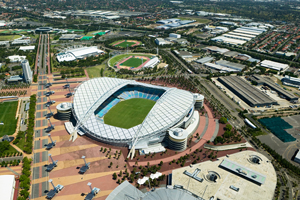
The changes in Sydney Olympic park are huge. These two pictures below show that before the Sydney Olympic games occurred, Home bush was a very quite place, a nice bush land area, but when the Olympics began, all of that was destroyed. This has drastically changed Australia because it caused an increase in population, and many more people from other countries coming to live in Australia.

BEFORE AFTER
This graph below shows, that in the last two years alone, the Australian dollar has increased dramatically in value, this has caused many people to cash in and earn lots of money, which can again change Australia, with some possible citizens going away on long holidays away whilst it is cheap, and it getting cheaper.

The graph below also shows us that the population of Australia in the past 20 years has again increased dramatically.

Use the following categories: physical change, socio-economic change, and cultural change. Have five changes for each category.
Choose ONE example from each category (three total). What are some of the ways that we can find out how Australia has changed in each of these categories? What research could we do to figure out how Australia has changed?
For each of the THREE from above find an answer. Then write a paragraph about how you think the information you have found has led to change in Australia. (put all this information in the same blog post)
Physical: Floods, droughts, Sydney Olympic park; from bush land to sports centre, erosion, deforestation.
Socio Economic: Carbon tax, urbanisation, GFC, income levels, value of the Aussie $.
Cultural: Population, multiculturalism; people from other countries moving to Australia, Change in government, global warming, new religions.
For physical changes, there are many different ways in which we could gather information, and example is we could use before and after photos of Sydney Olympic park before the 200 Olympics and after the 2000 Olympics. For Socio economic changes, we could definitely view the Australian dollar from ten years ago, and the Australian dollar this year. There would be changes in the strength of it and for Cultural changes we would be able to find out information, by the current population of Australia, to the population of Australia in the year 2001. The population this year would definitely be much higher then 10 years ago.
The changes in Sydney Olympic park are huge. These two pictures below show that before the Sydney Olympic games occurred, Home bush was a very quite place, a nice bush land area, but when the Olympics began, all of that was destroyed. This has drastically changed Australia because it caused an increase in population, and many more people from other countries coming to live in Australia.
BEFORE AFTER
This graph below shows, that in the last two years alone, the Australian dollar has increased dramatically in value, this has caused many people to cash in and earn lots of money, which can again change Australia, with some possible citizens going away on long holidays away whilst it is cheap, and it getting cheaper.
The graph below also shows us that the population of Australia in the past 20 years has again increased dramatically.
Thursday, June 16, 2011
Geo work on source/australia
1. What is a primary source when doing research? What is a secondary source? Which one is better? When do you use these types of sources? A primary source is a source which is from the time you are studying. a secondary source is a source past the time of the studied period. a primary source is better and more accurate than a secondary source. We use these types of sources when we study an event in history.
2. What is a primary source for finding population data for Australia? Why? A primary for finding the population of Australia is government sites and using graphs, they are reliable and they conduct the senses of the population.
3. What is the population of Australia? 22,638,341 people.
4. What is the 'growth rate' of Australia for 2010? 1.6%
5. How many 'new' Australians were there in 2010? 345,500
6. How many of the 'new' Australians were born in Australia and how many are immigrants? Born = 42 570 immigrants = 108,100
7. Which state had the greatest growth in population for 2010? Queensland
8. What changes have you noticed in your area that could be related to growth in population? That there are many people who are coming into our areas.
9. Is it good that Australia's population continues to grow? No.
10. When, in history, has Australia NEEDED the population to grow? Why? Where did these people come from? Since federation in 1901. Because they were going to be invaded by the Japanese and so we needed as many people as possible to survive the invasion. They all came from the Pacific.
Subscribe to:
Posts (Atom)